

If you’ve been running ads on Meta for a while, you’ve probably hit that point where things just stop working the way they used to.
One day your campaigns are running fine, then suddenly you’re dealing with restrictions, rejected ads, or worse, a disabled account. You try to appeal, wait for support, maybe even start over… and then it happens again.
At some point, most advertisers start asking the same question:
Is it something I’m doing wrong, or is it the account itself?
In many cases, it’s the account.
The difference between a personal ad account and an agency ad account plays a much bigger role than most people expect, especially once you start scaling.
In this guide, we’ll walk through how both account types actually work, where things tend to break down, and why more businesses are moving toward agency accounts in 2026.
What Is a Personal Meta Ad Account?
A personal Meta ad account is what most people start with by default. It’s the one you create inside Meta Business Manager, usually connected directly to your profile or your business page.
For beginners, it makes sense. It’s quick to set up, doesn’t cost anything, and gives you full control.
You’ll typically see personal accounts used by:
- small business owners running their own ads
- freelancers managing a few clients
- anyone just testing campaigns for the first time
At the start, it feels straightforward. You launch a few campaigns, test creatives, maybe get some early results.
But as you begin to increase spend or scale campaigns, things can shift.
Where personal accounts start to struggle:
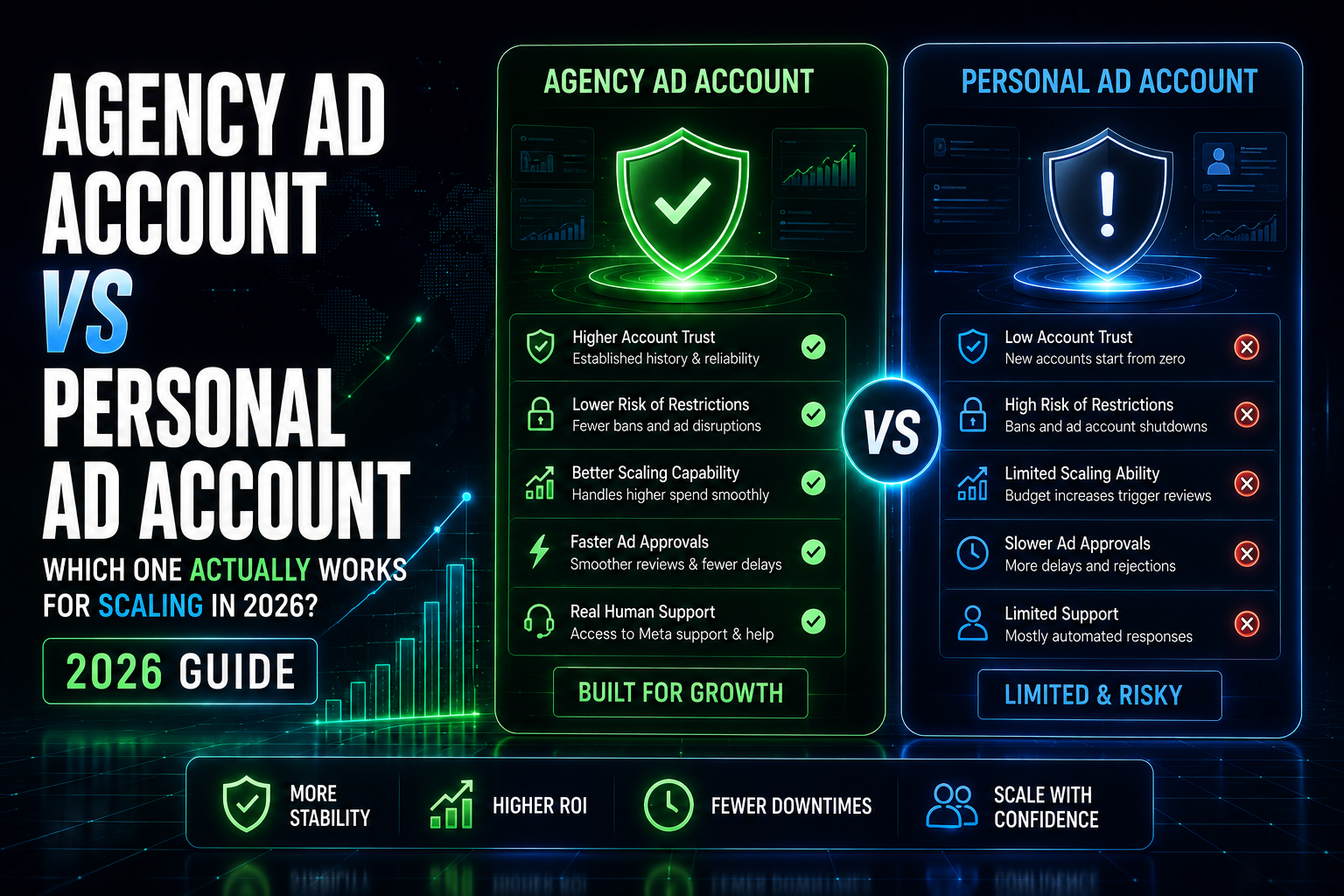
- They don’t have much account history
- Trust builds slowly over time
- Sudden changes like budget increases can trigger reviews
- Sensitive ad copy or creatives are not supported
And this is where a lot of advertisers run into issues, not because they’re doing something wrong, but because the account itself hasn’t built enough trust yet.
What Is an Agency Ad Account?
An agency ad account works differently.
Instead of creating a brand-new account and building trust from scratch, you’re using an account that already has history behind it. These accounts are typically managed by agencies that have established relationships with Meta.
When you work with a provider like Ad Guardians, you’re essentially plugging into a system that’s already been set up for stability.
That doesn’t mean you can ignore policies or run anything you want, but it does mean you’re starting from a stronger position.
What makes agency accounts different:
- They’ve already built trust over time
- They’re used to handling higher spend
- They’re monitored more closely for compliance
- There’s usually some level of support involved
For businesses that rely heavily on ads, this setup tends to feel a lot more stable compared to starting from zero.
Agency Ad Account vs Personal Ad Account: The Real Differences
On paper, the differences might look simple. But in practice, they show up in very real ways once you start running campaigns consistently.
Trust Level
Personal accounts start with very little trust. Over time, that can improve, but it’s gradual.
Agency accounts, on the other hand, already have that baseline trust built in.
Risk of Restrictions
This is probably the biggest one.
With personal accounts, it’s not uncommon to see:
- random ad rejections
- temporary restrictions
- full account shutdowns
Agency accounts aren’t immune to issues, but they tend to experience fewer disruptions overall.
Scaling Ability
With personal accounts, scaling too quickly can sometimes backfire.
You increase budget, performance improves… and then suddenly your account gets flagged.
With agency accounts, scaling tends to be more predictable because the account is already used to higher spend levels.
Support
This is another area where there is a noticeable gap.
On a personal account, Meta sees you as a small fish.
With limited spend behind your account, you simply do not get taken seriously, and support is slow or fully automated.
Agency ad accounts are created from a Business Manager that processes millions in spend, which means you have access to current Meta support and can get things done when it matters.
Agency setups often come with guidance too, not just for fixing issues, but for avoiding them in the first place.
Pros and Cons of Each Option
Let’s keep this realistic, both options have their place.
Personal Ad Account
Pros:
- Easy to set up
- No upfront cost
- Full control over everything
Cons:
- Higher risk of bans or restrictions
- Harder to scale consistently
- Limited support when things go wrong
Agency Ad Account
Pros:
- More stable environment for running ads
- Better suited for higher budgets
- Faster approvals in many cases
- Access to META support and guidance
Cons:
- Requires working with a provider
- May involve fees
- Onboarding takes a bit of time
Why Personal Ad Accounts Keep Getting Restricted
This is where most of the frustration comes from.
You follow the rules, your ads are compliant, and yet your account still gets flagged.
A lot of this comes down to how Meta’s systems work.
They’re heavily automated and designed to minimize risk. So when something changes quickly, like a spike in ad spend or a new campaign structure, it can trigger a review.
Common triggers include:
- sudden increases in budget
- new accounts with little history
- certain industries or offer types
- inconsistencies in account behavior
The tricky part is that even legitimate advertisers can get caught in this.
And once it happens a few times, it starts to slow everything down.
Common Mistakes Advertisers Make With Personal Accounts
From what we’ve seen, it’s not always just the system, sometimes it’s how the account is being used.
A few patterns come up pretty often:
- scaling too aggressively too early
- launching multiple campaigns at once without history
- ignoring small policy warnings
- not warming up the account gradually
None of these are unusual, especially if you’re trying to grow quickly. But on a low-trust account, they can increase the chances of getting flagged.
Can You Fix a Restricted Personal Ad Account?
Sometimes, yes.
You can appeal decisions, update billing info, or adjust campaigns. In some cases, accounts do get reinstated.
But the bigger question is reliability.
Even if you fix one restriction, there’s no guarantee it won’t happen again, especially if the underlying issue is the account’s trust level.
That’s usually the point where advertisers start looking for a more stable setup instead of constantly reacting to problems.
Why Businesses Eventually Switch to Agency Ad Accounts
At a certain stage, the cost of instability becomes too high.
If your ads are driving leads or sales daily, even a short interruption can have a noticeable impact.
That’s why many businesses eventually move toward agency accounts.
Not because they’re perfect, but because they’re more predictable.
What tends to improve:
- fewer unexpected shutdowns
- more consistent campaign performance
- less time spent troubleshooting
- more focus on optimization instead of recovery
For teams that rely on ads, that shift can make a big difference.
Why Ad Guardians Is Often Chosen as a Solution
There are quite a few providers out there, but not all of them offer the same level of structure or support.
Ad Guardians focuses specifically on helping advertisers run campaigns with fewer disruptions while staying compliant.
What stands out is that it’s not just about giving access to an account, there’s also a system around it.
That includes:
- onboarding to get everything set up properly
- guidance on how to avoid common issues
- a structure setup designed for scaling campaigns
If you want to look into how their plans are structured, you can check their pricing page here:
When It Makes Sense to Upgrade
Not everyone needs an agency account right away.
But there are some clear signs that it might be time:
- you’ve had multiple account bans
- you’re spending consistently on ads
- your business depends on paid traffic
- you’re trying to scale but keep getting blocked
If that sounds familiar, staying on a personal account can start to feel limiting.
Final Thoughts: Which One Should You Use?
There’s no one-size-fits-all answer.
If you’re just getting started, a personal ad account is usually enough. It’s simple, accessible, and good for testing.
But once you move beyond testing and start relying on ads for growth, stability becomes more important.
That’s where agency accounts tend to make more sense.
Start Scaling With a More Stable Setup
If you’ve been dealing with repeated restrictions or inconsistent performance, it might be worth looking at a different approach.
With Ad Guardians, you can run campaigns in a more stable environment and focus on scaling instead of constantly fixing issues.
Start your 7-day trial today:
Frequently Asked Questions
What is a Meta agency ad account?
It’s an ad account provided through a partner agency that already has trust and history with Meta.
Are agency ad accounts safe to use?
Yes, as long as you follow advertising policies. They’re designed to be more stable, not policy-free.
Why does Meta keep banning ad accounts?
Usually due to risk signals, account history, or automated reviews, not always clear violations.
Can beginners use agency ad accounts?
They can, but they’re typically more useful for businesses that are already spending on ads.
