

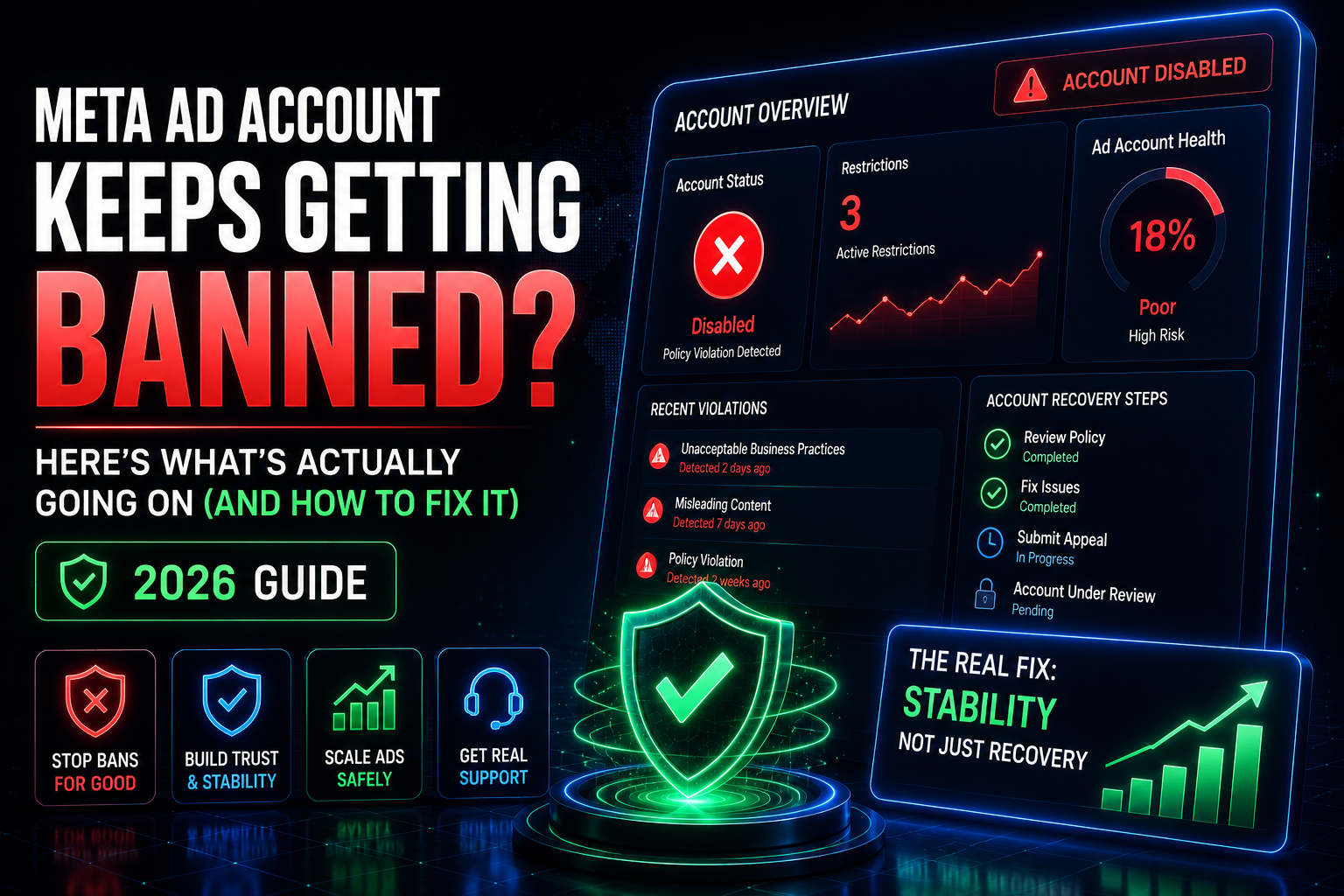
If your Meta ad account keeps getting banned, you’re definitely not the only one dealing with it.
This is something a lot of advertisers run into at some point.
Usually it starts the same way. You launch a campaign, things look fine, maybe even better than expected. Then suddenly, without much warning, there’s a restriction. Sometimes temporary. Sometimes not. You go through the appeal process, wait it out, maybe recover the account… and then later, it happens again.
After a while, it stops feeling random.
It starts to feel like there’s a pattern, even if it’s not obvious at first.
And that’s usually when people stop chasing quick fixes and start looking for something more reliable.
So instead of guessing, let’s break it down properly:
- why accounts keep getting banned
- what actually causes repeat issues
- what you can fix and what you can’t
- and what advertisers eventually do differently
Why Meta Ad Accounts Get Banned in the First Place
At the core of it, Meta is trying to manage risk.
Their system is built to flag anything that looks off, inconsistent, or potentially non-compliant.
The issue is, most of this process is automated.
So even when you’re following the rules, things can still get flagged.
Some common triggers you’ll see:
- sudden increases in ad spend
- new accounts without much history
- certain industries or offers
- creatives, ad-copy or landing pages that get flagged
The frustrating part is that explanations are rarely clear.
Why It Keeps Happening (Even After You Fix It Once)
This is where most people get stuck.
You fix one issue. Maybe you tweak the ad copy. Maybe you adjust the landing page or verify details.
Then it happens again.
That’s because the issue isn’t always the ad itself.
Sometimes it comes down to the account.
If the account has:
- low trust
- limited history
- previous flags
…it becomes more sensitive moving forward.
So even small changes can trigger another review cycle.
Common Fixes That Only Work Short-Term
If you’ve looked this up before, you’ve probably seen the usual advice.
Things like:
- rewriting ad copy
- swapping creatives
- submitting appeals
And yes, those can work for a while.
But they don’t fix the underlying problem.
If the account itself is unstable, you’re still dealing with the same limitations.
That’s why the issue keeps coming back.
What Actually Helps Reduce Bans Over Time
Instead of looking for a single fix, it helps to think in terms of lowering overall risk.
A few things that tend to help:
- scaling budgets more gradually
- keeping campaign behavior consistent
- making sure creatives follow guidelines
- verifying business details properly
These things do help, but they take time.
Even then, results aren’t always consistent.
The Role of Account Trust (And Why It Matters More Than You Think)
This part gets overlooked a lot.
Meta assigns a level of trust to each account, mostly based on history.
Accounts with higher trust:
- pass reviews more easily
- scale with fewer issues
- face fewer restrictions
Accounts with lower trust:
- get reviewed more often
- react more sensitively to changes
- are flagged more frequently
So when bans keep happening, it’s not just about what you’re doing. It’s also how the account is being evaluated behind the scenes.
Why Starting Over Doesn’t Always Fix the Problem
A common reaction is to create a new account.
At first, it feels like a reset.
But new accounts come with:
- no history
- low trust
- higher sensitivity
So in many cases, the same pattern repeats.
Starting over doesn’t always fix the issue. Sometimes it actually makes things more fragile.
What Most Advertisers Eventually Realize
After going through this cycle a few times, things start to click.
It’s not just about fixing ads.
It’s about the environment those ads are running in.
If that environment isn’t stable, everything else becomes harder to manage.
That’s usually when people start looking at different setups instead of quick fixes.
A More Stable Alternative to Repeated Fixes
Instead of constantly reacting, some advertisers move toward setups that are already more stable.
This is where agency ad accounts come in.
Instead of building trust from zero, you’re using accounts that already have:
- established history
- stronger trust signals
- more consistent performance
That doesn’t remove all risk, but it reduces how often issues come up.
Why Many Switch to Ad Guardians
One approach that comes up often is using Ad Guardians.
The shift here is simple. Instead of fixing the same problem repeatedly, you focus on running ads in a more stable setup.
From what we’ve seen, that usually includes:
- access to higher-trust accounts
- guidance to avoid common triggers
- a setup that supports scaling
It’s not about avoiding Meta’s system. It’s about working within it more effectively.
If you want to explore how it works, you can check their pricing here:
When It’s Time to Stop Fixing and Change the Setup
There’s usually a point where continuing to fix things stops making sense.
Some signs:
- repeated bans even when you follow guidelines
- difficulty scaling campaigns
- inconsistent results
- too much time spent on appeals
At that point, changing the setup can save a lot of time.
The Real Fix: Stability Over Constant Recovery
A lot of advice focuses on recovery.
But the bigger solution is stability.
When campaigns run consistently without interruptions, everything becomes easier:
- testing
- scaling
- optimizing
That’s what most advertisers are actually trying to achieve.
Start Running Ads With Fewer Interruptions
If your Meta ad account keeps getting banned and you’re tired of repeating the same process, it might be time to try something different.
With Ad Guardians, you can run campaigns in a more stable setup and focus on scaling instead of constantly fixing issues.
Start your 7-day trial today:
Frequently Asked Questions
Why does my Meta ad account keep getting banned?
Usually because of account trust, automated reviews, or sudden changes in activity.
Can banned accounts be recovered?
Sometimes. But repeated issues often point to a deeper problem.
Does creating a new account fix the issue?
Not always. New accounts start with low trust and can run into similar problems.
What’s the best long-term solution?
Improving stability, either over time or by using a more established account setup.
