

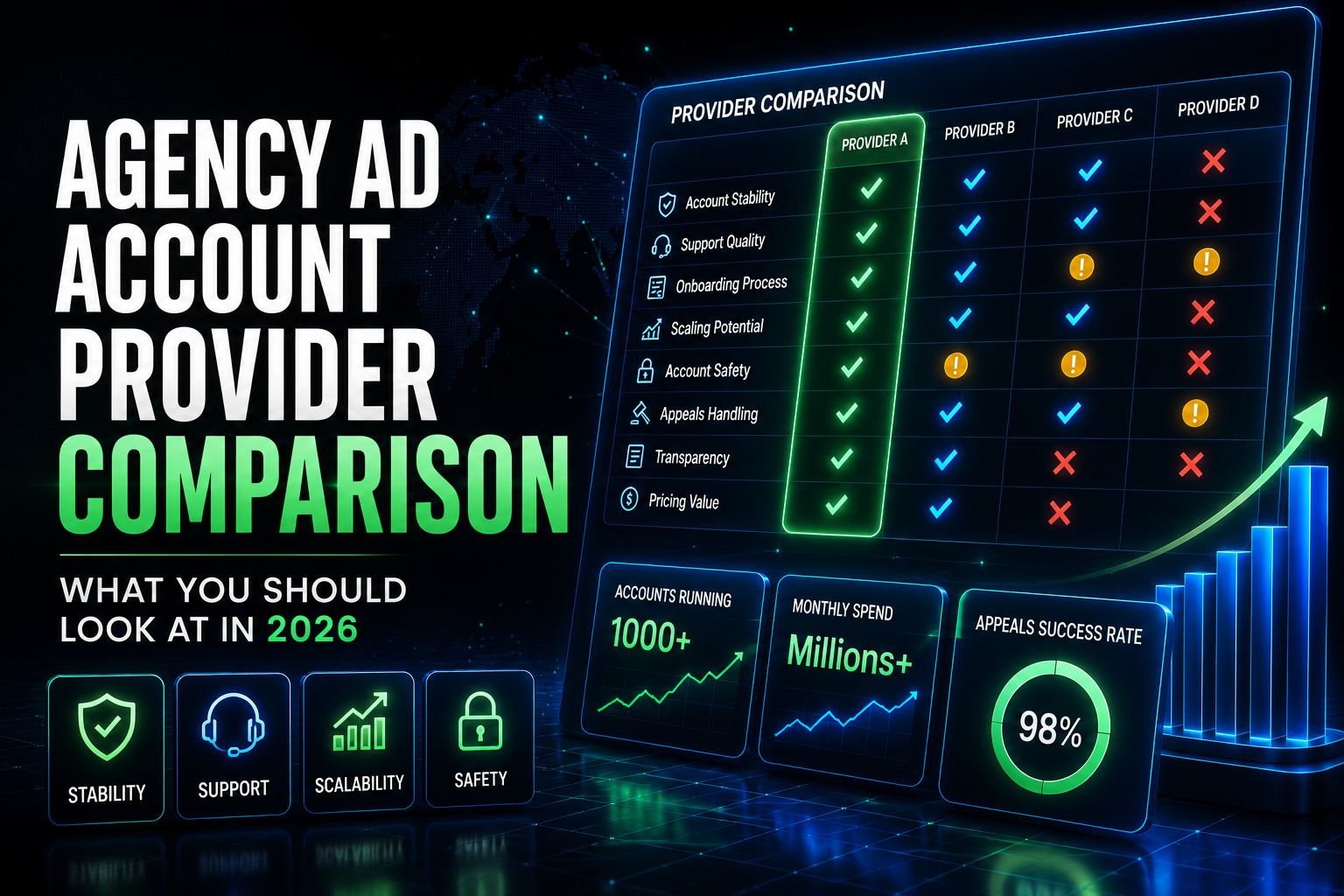
Most people don’t start by comparing agency ad account providers.
Usually, they get there after something goes wrong.
An account gets restricted. Campaigns stop running. Appeals take longer than expected. Then it happens again. And after a few rounds of that, it becomes pretty clear that something in the setup isn’t working the way it should.
That’s when the idea of switching comes up.
But once you start looking into different providers, it can feel like you’re reading the same thing over and over. Everyone talks about stability. Everyone mentions scaling. It all sounds similar.
So instead of trying to “pick the best one” right away, it helps to step back and look at how to actually compare them in a way that makes sense.
Why This Even Becomes a Problem
If you think about it, most advertisers begin in the same place.
You open a personal ad account, run a few campaigns, and things seem fine at first. Nothing complicated.
Then slowly, as you start increasing budgets or launching more campaigns, things get a bit unpredictable.
Sometimes ads get flagged. Sometimes accounts get reviewed. Other times, everything just pauses and you’re not entirely sure why.
And the tricky part is, even when you’re following the rules, it can still happen.
That’s usually the point where people start thinking:
maybe it’s not just the ads… maybe it’s the account itself.
What These Providers Are Actually Offering
At the simplest level, agency ad accounts are created from within an agency Business Manager.
The highest tier available is a Platinum Agency Business Manager, and the ad accounts created from it carry that same status.
What makes this possible is that the agency BM processes millions in spend per month, which is exactly what earns and maintains that Platinum status with Meta.
Because of that volume and the direct partnership with Meta, the agency owning the Platinum BM can appeal directly on your behalf when issues come up, something a standard setup simply does not offer.
With agency accounts, you are not starting from the same baseline as a new account still proving itself.
They already carry trust, behave more stably when running campaigns, and come with a layer of support behind them.
Not perfect, but a lot less fragile.
The Part Most People Skip When Comparing Providers
A lot of comparisons focus on features.
But in reality, features aren’t what usually cause problems.
It’s how everything is handled behind the scenes.
For example, two providers might both offer “agency ad accounts,” but:
- one gives you access and that’s it (re-selling)
- the other walks you through how to use it properly, handles appeals quickly when something needs to be escalated, and shares access when needed
On paper, that looks similar.
In practice, it feels very different after a few weeks.
What You Should Pay Attention To First
If you’re trying to narrow things down, there are a few things that tend to matter more than anything else.
Not in a checklist way, more in terms of how things actually play out over time.
One is stability.
If campaigns keep stopping or accounts keep getting flagged, it doesn’t really matter how good everything else looks.
Another is support.
Not just having someone to message, but actually getting useful answers when something comes up.
And then there’s onboarding.
It’s easy to overlook, but how things are set up at the beginning often determines how smooth things will be later.
Where Differences Start Showing Up
At first, most providers feel similar.
You get access, you start running ads, and everything seems fine.
But after a bit of time, small differences start to show.
With some setups:
- onboarding feels rushed
- you’re figuring things out on your own
- support is mostly reactive
With others:
- things are explained more clearly
- there’s guidance early on
- fewer avoidable issues come up
It’s not always obvious right away, but over time it adds up.
A More Structured Approach (Example)
One example of a more structured setup is Ad Guardians.
What’s noticeable isn’t just the access itself, but how things are introduced.
Instead of jumping straight into running ads, there’s usually a bit more attention on how everything is set up.
That might include:
- a clearer onboarding process
- some guidance on what to avoid early on
- a setup that’s meant to hold up as you scale
- the ability to recover accounts through a direct appeal submitted to their Meta support when needed
- full management of your entire ad account structure, including replacements wherever needed
It doesn’t mean nothing will ever go wrong. But it tends to reduce the number of avoidable issues.
If you want to get a sense of how they structure things, you can look at their plans here:
Things That Should Probably Raise a Flag
When you’re comparing providers, a few things are worth being cautious about.
If something sounds too easy, it usually is.
For example:
- guarantees of “no bans”
- very little explanation of how things work
- unclear pricing or setup
No speed limits on account sharing.
Those don’t always mean it’s a bad option, but they’re usually signs to ask more questions before committing.
Questions That Are Actually Worth Asking
Instead of focusing only on what’s advertised, it helps to ask a few practical questions.
Like:
- What happens if something gets restricted?
- How is onboarding handled?
- Is there guidance, or just access?
The answers don’t need to be perfect, but they should be clear.
When Switching Starts Making Sense
Not everyone needs to switch right away.
But there are certain situations where it becomes more relevant.
If you’ve gone through multiple account issues, or if scaling keeps getting interrupted, then it’s probably worth looking at alternatives.
At that point, it’s less about trying something new and more about fixing what’s not working.
What Most Advertisers Are Really Looking For
Interestingly, most people aren’t looking for something complicated.
They just want:
- campaigns to run consistently
- fewer unexpected problems
- a setup they don’t have to keep fixing
That’s really it.
And when those things are in place, everything else becomes easier to manage.
Start With a Setup That Feels More Stable
If you’ve been comparing providers and trying to figure out what actually makes sense, it might help to start with something that focuses more on stability than quick fixes.
With Ad Guardians, the idea is to run campaigns in a way that’s a bit more predictable, so you’re not constantly dealing with interruptions.
Start your 7-day trial today:
Frequently Asked Questions
What is an agency ad account provider?
It’s a service that gives access to ad accounts that already have higher trust and support with Meta.
Are all providers basically the same?
Not really. Differences usually show up in support, onboarding, and overall stability.
Is switching always necessary?
No, but it becomes more useful once you’re scaling or dealing with repeated issues.
Do agency accounts remove all risk?
No, they reduce friction, but how you run campaigns still matters.
